Category Archives: Toxins – Endocrine Disruptors

Jones 2023: Learning and memory deficits produced by aspartame are heritable via the paternal lineage

This gallery contains 1 photo.

Scientific Reports, Aug 31;13(1):14326. Jones, McCarthy, Stanwood, Schatschneider, Bhide Mice who drank the equivalent of only 16 oz to 32 oz of diet soda per day seemed just fine — but their babies weren’t.  Both male and female pups had … Continue reading →

More Galleries | Leave a comment

Edelkind-Noesges 2020: Vaccine Adjuvants and Selected Neurotoxins in ADHD and Autism

This gallery contains 1 photo.

Capstone for Masters Degree, Walden University, October 2020 This paper explores the connections between autism, everyday toxic exposures such as fluoridated water, and vaccine damage.  One important question, in particular, is whether the link may involve a deficiency of the … Continue reading →

More Galleries | Leave a comment

Dufault 2018: Food labeling requirements may explain lower autism and ADHD prevalence in the United Kingdom

This gallery contains 2 photos.

Integrative Food, Nutrition and Metabolism, 2018, 5(4): 1-2 This editorial explores possible nutritional reasons for the huge difference between the United States and the United Kingdom in numbers of children diagnosed with ADHD or autism. Food Dyes After two separate … Continue reading →
More Galleries | Leave a comment

Malin 2015: Exposure to fluoridated water and attention deficit hyperactivity disorder prevalence among children and adolescents in the United States: an ecological association

This gallery contains 2 photos.

Environmental Health, Feb 27;14:17. doi: 10.1186/s12940-015-0003-1. The authors comment that while environmental factors known to increase the risk of ADHD include exposure to manganese, poly-chlorinated biphenyls (PCBs), nicotine, mercury, arsenic, food additives, food coloring, pesticides and lead, almost no attention … Continue reading →
More Galleries | Leave a comment

Hormann 2014: Holding Thermal Receipt Paper and Eating Food after Using Hand Sanitizer Results in High Serum Bioactive and Urine Total Levels of Bisphenol A (BPA)

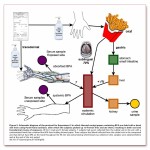
This gallery contains 3 photos.

PLoS One. 2014 Oct 22;9(10): e110509. If you must handle thermal receipts, don’t use sanitizers or hand lotion – both often contain chemicals that will encourage the BPA to slide right through your skin. In the experiment described in this … Continue reading →

More Galleries | Leave a comment

Mansouri 2016: Histopathological effects following short-term coexposure of Cyprinus carpio to nanoparticles of TiO2 and CuO

This gallery contains 2 photos.

Environmental Monitoring and Assessment. (2016) 188:575 This Swiss study looks at the effect of two kinds of nanoparticles, separately and combined.  Both copper oxide (CuO) and titanium dioxide (TiO2) ultrafine particles (nanoparticles or NP) are widely used in many things … Continue reading →

More Galleries | Leave a comment

Jovanovic 2016: Food web effects of titanium dioxide nanoparticles in an outdoor freshwater mesocosm experiment.

This gallery contains 2 photos.

Nanotoxicology. 2016 Sep;10(7):902-12. In this study, 25 µg/L and 250 µg/L of the food color additive titanium dioxide (TiO2) nanoparticles were added to outdoor mesocosms* placed in a lake.  The control mesocosm was not treated with any TiO2. * A … Continue reading →
More Galleries | Leave a comment

Lanphear 2015: The impact of toxins on the developing brain.

This gallery contains 2 photos.

Annual Review of Public Health,  2015 Mar 18;36:211-30. The objective of this review is to provide an overview on the population impact of toxins on the developing brain and describe implications for public health. QUOTE:  “The blood–brain barrier of the … Continue reading →

More Galleries | Leave a comment

Dodson 2012: Endocrine disruptors and asthma-associated chemicals in consumer products

This gallery contains 1 photo.

Environmental Health Perspectives, 2012. Jul;120(7): 935-43. Dodson, Nishioka, Standley … Rudel In this study, the authors measured chemicals in cosmetics, personal care products, cleaners, sunscreens, and vinyl products, to determine what they contain in the way of asthma-causing chemicals and endocrine disruptors … Continue reading →

More Galleries | Leave a comment

Curtis 2008 Nutritional and environmental approaches to preventing and treating autism and attention deficit hyperactivity disorder (ADHD): a review

This gallery contains 2 photos.

Journal of Alternative and Complementary Medicine, 2008.  Jan-Feb; 14(1): 79-85.  Curtis & Patel This is a review of literature available in 2008. The authors say many of the studies link exposure to toxins such as mercury, lead, and pesticides, as well … Continue reading →
More Galleries | Leave a comment