Category Archives: Preservatives

Feingold Successes

This gallery contains 2 photos.

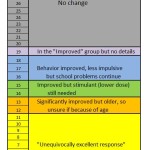
Feingold Successes Do you have a child with serious problems, and have you been unable to find any real solutions? Like many of us, you may have consulted numerous professionals and received nothing more than a label or a prescription. … Continue reading →

More Galleries | Leave a comment

Edelkind-Noesges 2020: Vaccine Adjuvants and Selected Neurotoxins in ADHD and Autism

This gallery contains 1 photo.

Capstone for Masters Degree, Walden University, October 2020 This paper explores the connections between autism, everyday toxic exposures such as fluoridated water, and vaccine damage.  One important question, in particular, is whether the link may involve a deficiency of the … Continue reading →
More Galleries | Leave a comment

Dolp 2020: Oligoantigenic diet improved children’s ADHD rating scale scores reliably in added video-rating

This gallery contains 2 photos.

Frontiers in Psychiatry, August 2020, Volume 11, 730, pp. 1-12.  Dolp, Schneider-Momm, Heiser …& Fleischhaker An oligoantigenic diet is a few-foods diet, used sometimes to identify foods a child may be allergic to.  It excludes all the food dyes, preservatives, … Continue reading →

More Galleries | Leave a comment

Archives – FAWA 1979, July

This gallery contains 1 photo.

Dr. Feingold comments on the FDA study The Kaiser-Permanente/University of California study funded by the FDA is commonly referred to as the FDA study. The study was supportive. One child out of 22 children under controlled conditions reacted unequivocally to … Continue reading →

More Galleries | Leave a comment

Prabhakaran 2017: Benzalkonium Chloride: A Bronchoconstricting Preservative in Continuous Albuterol Nebulizer Solutions.

This gallery contains 2 photos.

Pharmacotherapy. 2017 May;37 (5): 607-610. Albuterol in bottles used for multiple dosing contains benzalkonium chloride (BAC) as a preservative.  The authors say that many pediatric hospitals use this kind of albuterol when preparing solutions for continuous nebulized albuterol for asthma … Continue reading →

More Galleries | Leave a comment

Sasaki 2002: The comet assay with 8 mouse organs: Results with 39 currently used food additives

This gallery contains 3 photos.

Mutation Research. 2002 Aug 26; 519(1-2): 103-19. Sasaki et al, in Japan, tested 39 common food additives — dyes, color fixatives, preservatives, antioxidants, fungicides, and sweeteners.   They gave each additive separately by mouth to groups of four male mice, and … Continue reading →

More Galleries | Leave a comment

Konikowska 2012: The influence of components of diet on the symptoms of ADHD in children

This gallery contains 2 photos.

Roczniki Panstwowego Zakladu Higieny. 2012;63(2): 127-34 In this review of ADHD treatments, Konikowska describes hyperactivity as a genetic trait connected to abnormal brain maturation, likely related to less activity by neurotransmitters dopamine and norepinephrine.  While stimulant medications effectively increase the … Continue reading →

More Galleries | Leave a comment

Corder 1995: Aspirin, salicylate, sulfite and tartrazine induced bronchoconstriction. Safe doses and case definition in epidemiological studies

This gallery contains 2 photos.

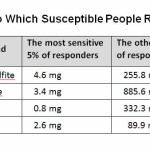
Journal of Clinical Epidemiology, 1995. Oct;48(10):1269-75, Corder & Buckley Corder estimated safe doses to use for epidemiological studies by studying reactions of patients in an allergy clinic. He said that reactions to the four compounds listed in the table are common, … Continue reading →
More Galleries | Leave a comment

McCann 2007: Food additives and hyperactive behaviour in 3-year-old and 8/9-year-old children in the community: a randomised, double-blinded, placebo-controlled trial

This gallery contains 1 photo.

Lancet, September 6, 2007 As a followup to the earlier Bateman (2004) study, the authors retested 153  toddlers as well as 144 elementary school (8/9 years old) children from the general population.   They were briefly put on a dye-free … Continue reading →

More Galleries | Leave a comment

Dengate 2002: Controlled trial of cumulative behavioural effects of a common bread preservative

This gallery contains 2 photos.

Journal of Paediatrics and Child Health, 2002. Aug;38(4):373-6.  Dengate & Ruben In Australia, 27 children whose behavior had improved on the Royal Prince Alfred Hospital diet were enrolled in a double-blind placebo-controlled test of the bread preservative calcium propionate (preservative … Continue reading →

More Galleries | Leave a comment

Schoenthaler 1986: The Impact of a Low Food Additive and Sucrose Diet on Academic Performance in 803 New York City Public Schools

This gallery contains 4 photos.

International Journal for Biosocial Research, 1986, 8(2); 185-195. Over 4 years, 803 New York City schools changed their breakfast and lunch programs.  They lowered sucrose, synthetic food color/flavors, and two preservatives (BHA and BHT). For each change, there was an … Continue reading →

More Galleries | Leave a comment

Egger 1985: Controlled Trial of Oligoantigenic Treatment in the Hyperkinetic Syndrome

This gallery contains 1 photo.

The Lancet, 9;1(8428):540-5.  Egger, Carter, Graham, Gumley, & Soothill 62 of 76  (81.6%) overactive children improved by at least one grade level on an oligoantigenic (few foods) diet.  Benzoic acid and tartrazine (Yellow 5) were the most common problems, but all … Continue reading →
More Galleries | Leave a comment

Feingold 1982: The role of diet in behaviour

This gallery contains 2 photos.

Ecology of Disease, 1982. 1(2-3):153-65 QUOTE:The increase in behavioural disorders accompanied by a persistent drop in scholastic performance coupled with the continuing rise in the prevalence of delinquency is undoubtedly one of the most important expressions of the disruption of … Continue reading →

More Galleries | Leave a comment

Feingold 1979: Dietary management of juvenile delinquency

This gallery contains 2 photos.

International Journal of Offender Therapy and Comparative Criminology, 1979. Vol 23(1) 73-84. QUOTE:  “This disenchantment with present-day rehabilitation techniques prompted the Ford Foundation in its annual report for 1977 to recommend that the role in delinquency of biochemical and organic … Continue reading →
More Galleries | Leave a comment

Brenner 1977: A study of the efficacy of the Feingold diet on hyperkinetic children. Some favorable personal observations.

This gallery contains 2 photos.

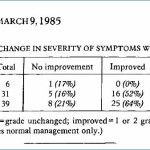
Clinical Pediatrics (Phila) 1977 Jul;16(7):652-6 (Case studies) When 32 hyperactive children Dr. Brenner had been treating medically for years were given the Feingold diet, 11 of them — 34.3% —  “markedly improved.“  Another 2 improved as much but were older, … Continue reading →
More Galleries | Leave a comment