Category Archives: ADHD

Harley 1978: Hyperkinesis and food additives: testing the Feingold hypothesis

This gallery contains 2 photos.

Pediatrics, 1978. Jun;61(6):818-28 In a double-blind diet study in which all food was provided for a “Feingold Diet” and a “control diet,” parents of 63% of the 36 school-age children and 100% of the 10 preschool children reported improved behavior … Continue reading →

More Galleries | Leave a comment

Harper 1978: Nutrient intakes of children on the hyperkinesis diet

This gallery contains 2 photos.

Journal of the American Dietetic Association, 1978 Nov;73(5):515-9 Harper calculated the nutrient intake of 54 children before and on the Feingold diet.   They were as good or better than the Recommended Dietary Allowances (RDA) — in other words, the … Continue reading →

More Galleries | Leave a comment

Hindle 1978: The management of hyperkinetic children: a trial of dietary therapy

This gallery contains 2 photos.

New Zealand Medical Journal, 1978. Jul 26;88(616):43-5. QUOTE:  “Ten hyperkinetic children have been treated with the [Feingold] diet, five of whom improved dramatically and are now off all other therapy. Their response to accidental and deliberate challenge supports the hypothesis … Continue reading →

More Galleries | Leave a comment

Levy 1978: Hyperkinesis and diet: a double-blind crossover trial with a tartrazine challenge

This gallery contains 1 photo.

Medical Journal of Australia, 1978. Jan 28;1(2):61-4 In this double-blind study of 22 hyperactive children, Levy put them on an elimination diet for four weeks and then challenged them with Yellow 5.  She reported that their improvement in the first … Continue reading →

More Galleries | Leave a comment

Rose 1978: The functional relationship between artificial food colors and hyperactivity.

This gallery contains 2 photos.

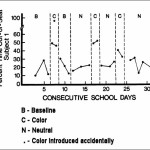
Journal of Applied Behavior Analysis 1978 Winter; 11(4):439-46 This was a double-blind study on two girls who had been on the Feingold diet for almost a year. Trained observers watched them in school and reported on the frequency of the … Continue reading →

More Galleries | Leave a comment

Williams 1978: Relative effects of drugs and diet on hyperactive behaviors: an experimental study

This gallery contains 1 photo.

Pediatrics. 1978 Jun;61(6):811-7. 26 hyperactive children were given a “modified” Feingold diet in which artificial food dyes and flavorings were eliminated, but not preservatives or salicylates.    They were then challenged in four ways: Cookie with 13 mg food dyes + … Continue reading →

More Galleries | Leave a comment

Brenner 1977: A study of the efficacy of the Feingold diet on hyperkinetic children. Some favorable personal observations.

This gallery contains 2 photos.

Clinical Pediatrics (Phila) 1977 Jul;16(7):652-6 (Case studies) When 32 hyperactive children Dr. Brenner had been treating medically for years were given the Feingold diet, 11 of them — 34.3% —  “markedly improved.“  Another 2 improved as much but were older, … Continue reading →

More Galleries | Leave a comment

Feingold 1977: Food additives in dentistry

This gallery contains 2 photos.

Journal of the American Society for Preventive Dentistry, 1977 Jan-Feb;7(1):13-5. QUOTE:   “The presence of food additives in products used in dental procedures may have serious consequences for many patients. Hyperactivity and learning disabilities as well as buccal, gingival and … Continue reading →

More Galleries | Leave a comment

Feingold 1977: Hyperkinesis and Learning Disabilities Linked to the Ingestion of Artificial Food Colors and Flavors

This gallery contains 2 photos.

Speech to American Academy of Pediatrics, New York Hilton Hotel, November 8, 1977. QUOTE:  ”Recognizing that any compound under the appropriate conditions can induce adverse reactions, including behavioral disturbances, it becomes necessary to evaluate each compound or class of compounds … Continue reading →

More Galleries | Leave a comment

Conners 1976: Food additives and hyperkinesis: a controlled double-blind experiment

This gallery contains 1 photo.

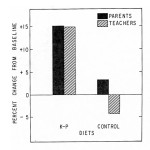
Pediatrics,  1976 Aug;58(2):154-66. Conners, Goyette … Andrulonis In a double-blind crossover study, 15 children were given a control diet and the “K-P” (Feingold) diet eliminating artificial flavors, colors, and natural salicylates. QUOTE:  “Both parents and teachers reported fewer hyperkinetic symptoms … Continue reading →

More Galleries | Leave a comment

Cook 1976: The Feingold dietary treatment of the hyperkinetic syndrome

This gallery contains 1 photo.

Medical Journal of Australia. 1976 Jul 17;2(3):85-8, 90.   Cook & Woodhill In Australia, 15 children were given the Feingold diet.  Parents of 13 of them (87%) reported improvement in their children’s behavior and a relapse upon eating off-diet items. MedLine|| … Continue reading →

More Galleries | Leave a comment

Feingold 1976: Hyperkinesis and Learning Disabilities Linked to the Ingestion of Artificial Food Colors and Flavors

This gallery contains 2 photos.

Feingold76Journal of Learning Disabilities, 1976. Vol.9(9) pp.19-27 Dr. Feingold reviews the historical background of hyperkinesis (hyperactivity) and learning disabilities, and discusses the food additives.   He explains the importance of artificial food dyes and flavors. MedLine || Full Text

More Galleries | Leave a comment

Salzman 1976: Allergy testing, psychological assessment and dietary treatment of the hyperactive child syndrome

This gallery contains 2 photos.

Medical Journal of Australia 1976 Aug 14;2(7):248-51 Thirty-one children with behavioural problems and learning difficulties were allergy tested … 15 of them were given the Feingold diet (then called the KP Diet).  Ninety-three per cent (93%) responded with improved behaviour … Continue reading →
More Galleries | Leave a comment

Feingold 1975: Hyperkinesis and learning disabilities linked to artificial food flavors and colors

This gallery contains 2 photos.

The American Journal of Nursing, 1975 May;75(5):797-803. QUOTE:  “… It is important to recognize that this entire behavioral pattern is beyond the child’s voluntary control. He does not choose to be a failure nor does he want to be bad. … Continue reading →
More Galleries | Leave a comment